Flying in the face of nomenclature, the classic
Periodic Table doesn't quite fit into a two-dimensional, rectilinear grid. There have been many attempts to improve the layout, some of which turn to the third dimension to solve the problem of those pesky
lanthanides and
actinides. One of the most pleasing is
Mendeleev's Flower, but even this is quite complicated and fiddly.
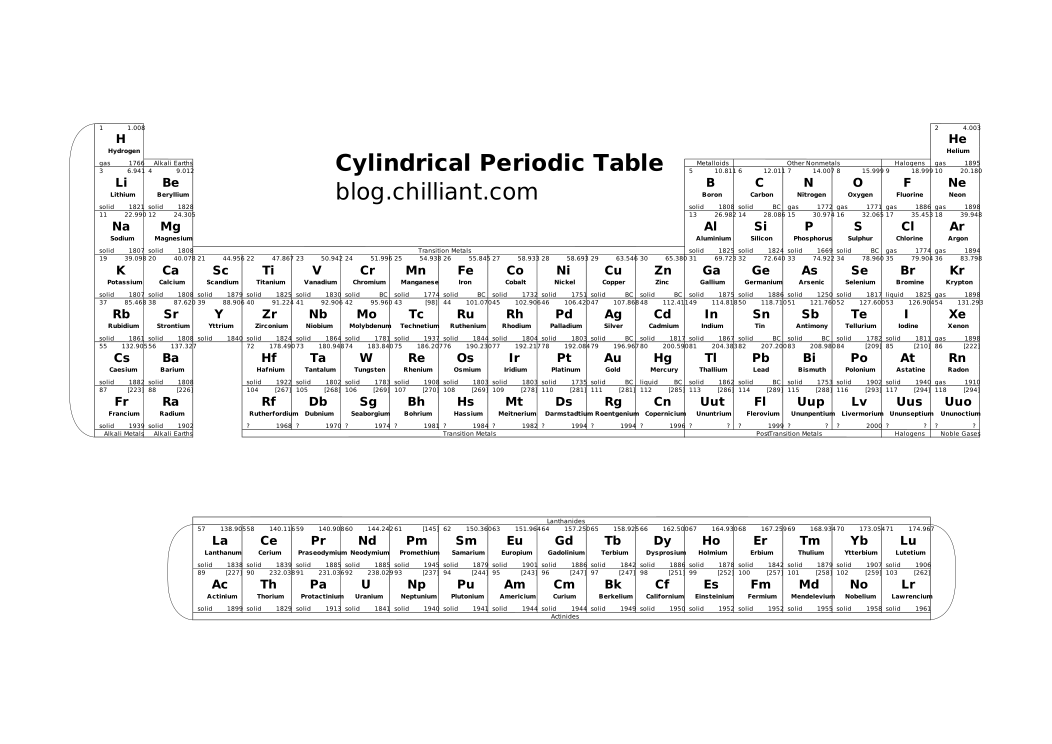
I decided to design a simple, three-dimensional, paper construction myself, based on data from Wikipedia. Here's a Google SketchUp rendering of my first attempt:
Each cell has six pieces of information:
- Top-left: the atomic number;
- Top-right: the atomic mass (or most stable mass number in square brackets);
- The chemical symbol;
- The English name;
- Bottom-left: the element's state at zero Celsius and one atmosphere pressure; and
- Bottom-right: the date of discovery or first isolation.
Here are the construction sheets for cutting out and gluing. Use the SVGs: they employ vector graphics.
There are little glue tabs to help you create the cylinders. Glue the purple strip within the gap in the lower-left corner of the main table.
So well and good, but the eagle-eyed amongst you may have noticed that with the cylindrical scheme although hydrogen (Z=1) and helium (Z=2) are neighbours, helium (Z=2) and lithium (Z=3) are
not.
The solution is to use a helical layout: the atomic numbers then spiral down in sequence. But in order for the construction to sit nicely on a flat surface, we need to skew the cells slightly:
I think it's fairly obvious how to make, but just in case...
First, print out the SVG on the largest sheet you can:
Then, cut out the two sections and fold forward the glue tabs:
Next, glue the lower section within the gap of the main table:
Finally, form a cylinder of the main table:
It's as simple as that. Not exactly nuclear physics...
UPDATE 2016-10-22 : As '
unlikelygrad' kindly pointed out, I misspelled "Noble Gases" in the original PDFs, so I've corrected that and uploaded the files as SVGs (there's now much better native support in browsers)